
There is a version of this conversation I have almost every week now, and it very often begins with a New Yorker. Sometimes it is a finance person in Tribeca, sometimes a physician on the Upper West Side, sometimes a couple who sold a Brooklyn brownstone at the top of the market and are sitting on more liquidity than they know what to do with. They have watched their own city become the most expensive per square foot it has ever been, they have priced a Hamptons second home and flinched, and somewhere in the back of their mind is a memory of a week in Rio de Janeiro that has never quite left them. They reach us through the site and they ask the same essential question: for the money I would spend on a modest apartment in Manhattan, what does the same money buy on the beach in Rio, and is the idea as good as it sounds at two in the morning. This piece is the long-form answer, and it is the version of the conversation I would rather have with you before you booked a flight than after.
Let me be straight about my seat at the table, because the rest only lands if you trust it. I am a Rio broker. I sell and manage apartments in Ipanema, Leblon, Copacabana, Joá and São Conrado, and I obviously have an interest in you deciding that Rio is the answer. I have written this comparison to be useful rather than persuasive, which means that when New York is the better call — and there are buyers for whom it plainly is — I say so in as many words. What I can promise is that the numbers below are the real numbers I work with every day, translated across two currencies as fairly as I know how, and that the places where the comparison flatters Rio are places where it flatters Rio in reality and not only on the page. Treat this as the start of your own due diligence, not the end of it.
01 · Why a New Yorker is looking at Rio
The New York buyer who ends up in my inbox is almost never a first-time investor chasing a yield they read about. They are usually the opposite: someone who already owns their New York home, who understands real estate intimately because they have transacted in the hardest market in the world, and who is looking for something their own city can no longer give them at a price that makes sense. What they are actually buying is a combination of three things that Manhattan sells at an extraordinary premium and Rio sells at a fraction of it — space, light and water. A prime Rio apartment gives you a scale of living, an amount of sky, and a relationship to the ocean that the equivalent New York money simply cannot touch north of a certain postcode.
There is also a timing story specific to 2026, and it is mostly a currency story. The Brazilian real is weaker against the dollar than it has been across most of the last fifteen years, which means an American buyer is entering the Rio market at what amounts to a large and durable discount to what local buyers paid for the same buildings a decade ago. That is not a trick and it is not a bubble; it is the arithmetic of a soft currency meeting a strong one, and it has quietly turned Rio into the most apartment-for-the-dollar that a design-literate American buyer can find in a genuinely global city. The New Yorkers who see this first are, more often than not, the ones who travel and who have noticed that their money goes further everywhere south of the equator than it did five years ago.
The third reason is harder to put a number on and matters more than the first two combined for buyers who intend to actually spend time in the apartment. New York is magnificent and relentless. Rio is magnificent and forgiving. The New Yorker who buys in Ipanema is frequently buying an antidote to the specific texture of their own life — a place where the pace drops, where the ocean is a two-minute walk rather than a summer share, and where the version of themselves that shows up on the second morning is a version they like better. None of that is on a spreadsheet, and all of it is why the deal gets done.
02 · Price per square foot, translated honestly
The single most useful thing I can do for a New York buyer is put the two cities on the same measuring stick, because the gap is so large that it reframes the entire decision. New Yorkers think in dollars per square foot; Brazilians think in reais per square metre. Translated to a common frame — US dollars per interior square foot, prime residential, the realistic middle of each market rather than the trophy penthouse — this is the picture.
Read that chart slowly, because it is the whole argument in one picture. Prime Manhattan trades at roughly three-and-a-half to four times the price per square foot of prime Ipanema, and closer to five times the price of Copacabana seafront. A Leblon apartment — Leblon being the single most expensive address in Rio, the local equivalent of the very best New York blocks — still costs less than a third of what a comparable prime Manhattan apartment costs on the same per-foot basis. This is not because Rio real estate is inferior. The best 1970s Ipanema buildings have ceiling heights, proportions and terrace depths that most new Manhattan towers cannot match, and the view from a good Vieira Souto apartment is one of the great residential views on earth. The gap is currency and geography, not quality.
What the per-square-foot number hides
Two honest caveats before a New Yorker gets carried away. First, the way space is measured differs. New York luxury increasingly quotes generous interior footage; Brazilian listings quote total private area that can include walls and a balcony, so the effective usable difference is a touch smaller than the raw numbers suggest — though even after that correction, Rio is a fraction of the New York price. Second, and more importantly for your ten-year budget, condominium fees and the running cost of ownership are a different shape in each city. A prime New York condo carries common charges plus real-estate taxes that together can run many thousands of dollars a month; a comparable Rio building charges a condomínio fee and an IPTU that, combined, are typically a fraction of the New York carry. The sticker price is one number. The cost of holding the thing for a decade is the number that actually decides whether the trade was smart, and on that second number Rio wins by even more than the first chart shows.

03 · What one-and-a-half million actually buys
Abstract per-foot numbers persuade nobody. What persuades people is a side-by-side of the actual apartment, so here is the honest version at the budget I see most often from a New York buyer, one and a half million US dollars, all in.
In Manhattan, $1.5M buys you a one-bedroom, or a modest and slightly tired two-bedroom in a good-but-not-trophy prime building, somewhere in the range of five hundred and fifty to seven hundred and fifty square feet of interior space. It will have a doorman, it will be a sound asset, and it will feel — to a New Yorker — completely normal, because it is completely normal. It is a competent apartment in an expensive city. You will not walk into it and gasp.
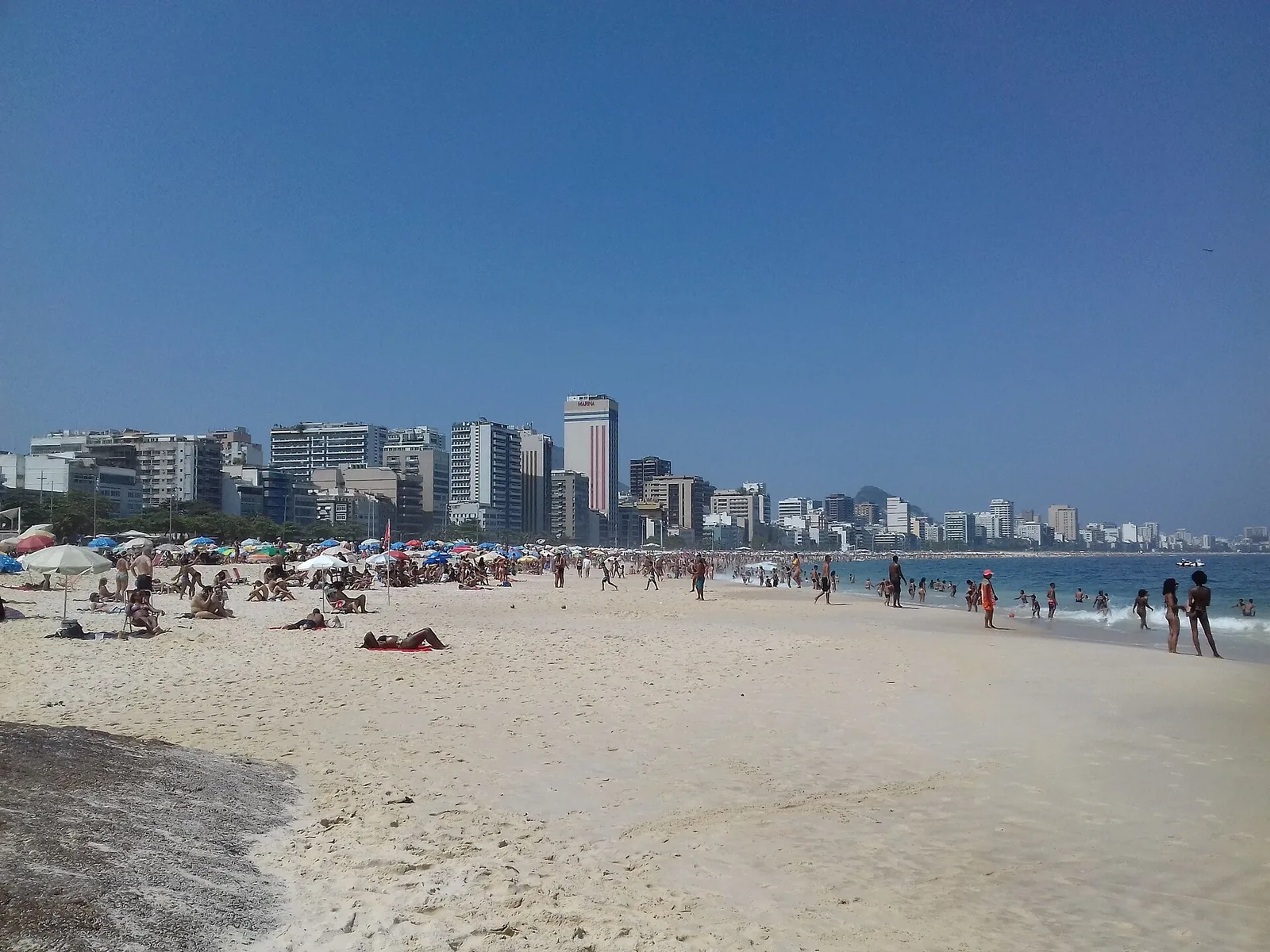
In Ipanema, the same $1.5M buys you a genuinely beautiful three-bedroom of a hundred and fifty to two hundred square metres — call it sixteen hundred to twenty-one hundred square feet — a short walk from the beach, quite possibly with a view of the water or the Lagoa, in a well-run building with a doorman team and, at the upper end of that budget, a parking space and a pool. In Copacabana, on the seafront itself, the same money buys you something even larger, or the same size with money left over to renovate to a very high standard. This is the moment the comparison stops being theoretical for most buyers. The New York money that buys a competent one-bedroom in Manhattan buys, in Rio, the kind of apartment that people plan holidays around and that changes how you feel about your own life. That contrast, more than any yield figure, is what closes the emotional distance between the two cities.
I want to be fair to New York here, because there is a real argument on the other side and a New York buyer deserves to hear it stated at full strength. What your New York one-bedroom has that your Rio three-bedroom does not is the single deepest, most liquid, most institutionally trusted real-estate market on the planet, denominated in the world's reserve currency, in a city whose long-run trajectory almost nobody bets against. That is worth a great deal, and for a buyer whose entire priority is capital preservation in hard currency with maximum liquidity, it can be worth paying four times the price per foot to have it. The Rio apartment is the better life and, on the numbers, the better yield. The New York apartment is the more certain store of value. Both of those sentences are true at the same time, and which one matters more is a fact about you, not about the two cities.
04 · The yield gap nobody in New York believes
If the price-per-foot chart is the part that makes a New Yorker lean forward, the yield chart is the part they refuse to believe until I show them the actual booking calendars from apartments we run. New York prime residential is, famously, a low-yield asset. You do not buy a Manhattan condo for the rent; you buy it for the appreciation and the store of value, and the gross yield on a prime unit, before the substantial costs, sits in the low single digits. Rio, run properly, is a different category of animal.
The reason for the gap is structural and worth understanding rather than just celebrating. Rio's yield advantage comes overwhelmingly from the short-stay market, which the city's prime residential zones in the Zona Sul still permit in a way that is increasingly rare among global cities. A well-located, well-furnished, professionally managed Copacabana or Ipanema apartment earns in dollars-equivalent from a global stream of visitors who will pay a strong nightly rate to wake up on that beach, and it earns it across most of the calendar because Rio's high season is long and its shoulder seasons are mild. New York, by contrast, has effectively legislated the high-yield short-stay model out of existence for this kind of apartment; Local Law 18 has made legal short-term rental of a typical Manhattan condo largely impractical, which pins the New York owner to the annual-lease yield, and the annual-lease yield on prime Manhattan is low by design.
The honest footnote is the one on every yield chart in this Journal: the gross is not the number you keep. Management, cleaning, platform fees, vacancy, the condomínio, the IPTU and the taxes take a real bite, and net lands somewhere between a third and a half below the headline in Rio exactly as it does in New York. But even after that haircut, a well-run Copacabana apartment nets a multiple of what a prime Manhattan condo nets, and it does so while you also hold the currency-appreciation option. For a New York buyer who has spent a career accepting sub-four-per-cent gross yields as simply the cost of owning trophy property, the first honest Rio net-yield conversation tends to be the one that reframes the whole idea from indulgence to investment.

05 · Taxes in two countries
This is the section New York buyers most want and most need, and it is also the section where I have to be most careful, because a foreign purchase means you are living in two tax systems at once and the interaction between them is genuinely specific to your situation. Read what follows as the frame for the conversation with your own cross-border accountant, not as a substitute for it. With that said, here is the honest shape.
What Brazil takes
A non-resident foreign owner of a Rio apartment meets a tax regime that is, by New York standards, refreshingly simple. Rental income earned by a non-resident is taxed under a withholding regime at a flat fifteen per cent, remitted monthly. Annual municipal property tax — the IPTU — runs roughly six-tenths to one-and-two-tenths of a per cent of the assessed value, and the assessed value sits below the market price, so the effective rate on what you paid is lower still. When you sell, capital gains are taxed on the gain measured in reais at a rate that starts at fifteen per cent and steps up only for very large gains. There is no Brazilian wealth tax and no annual federal property tax. The single largest cost at purchase is the ITBI transfer tax, which I cover in the closing-cost guide; total buyer-side closing costs land in the six-to-eight-per-cent range.
What the United States still takes
Here is the part New Yorkers frequently forget: buying abroad does not remove you from the American tax system, because the United States taxes its citizens and residents on worldwide income no matter where the asset sits. Your Rio rental income is reportable to the IRS on Schedule E, your eventual capital gain is reportable, and — because the apartment is a foreign asset held through foreign accounts — you will very likely have FBAR and FATCA reporting obligations on the Brazilian bank account the purchase requires. The saving grace is the foreign tax credit: the fifteen per cent Brazil withholds on your rent generally credits against the US tax you would otherwise owe on the same income, so in most cases you are not taxed twice on the same dollar, even though — and this matters — the United States and Brazil do not have a comprehensive income-tax treaty. The absence of a treaty makes the paperwork more attentive, not the tax bill dramatically higher, provided you file the credit correctly.
And what New York itself takes, for contrast
It is worth putting the New York purchase's own tax friction on the table, because New Yorkers tend to under-remember it. A New York City purchase at this budget carries a state-and-city mansion tax that is progressive above one million dollars, mortgage recording tax if you finance, title insurance and attorney costs on the way in; and on the way out, the seller faces a New York City and State transfer tax of roughly one-and-a-half to two per cent on top of a full brokerage commission, with a co-op flip tax on some buildings. New York's round-trip transaction friction on prime property is among the highest of any city I compare, higher in total than Rio's. The New York buyer who thinks of the Rio closing costs as the exotic, expensive ones has usually not added up their own.
The net of the whole tax picture, decided on the practical question of whether an ordinary intelligent owner can understand and execute it, is that the Brazil side is simpler than New Yorkers fear and the US side is more involved than they expect — but the combination is entirely workable, it does not require an offshore structure, and thousands of American owners run it cleanly every year with a competent cross-border accountant and a local Brazilian one. The tax is a reason to prepare, not a reason to walk away.
06 · The flight — the argument that wins the dinner table
Of all the reasons Rio makes unusual sense specifically for a New Yorker rather than for a European or a Californian, the strongest and least discussed is the geography of getting there. Rio de Janeiro sits almost directly south of New York. The flight from the New York airports to Rio's international airport is roughly nine and a half to ten hours, nonstop, and it is an overnight redeye: you have dinner in Manhattan, you sleep on the plane, and you have breakfast looking at Sugarloaf. There is no meaningful jet lag, because there is almost no time difference — Rio runs one to two hours ahead of New York depending on the season, which is to say, functionally the same day, the same working hours, the same rhythm.
Think about what that does to the practicality of a second home. A Hamptons house is three hours in Friday traffic each way. A Rio apartment is an overnight flight with no jet lag, landing you in a different hemisphere's summer in the same time zone you left. A New Yorker can keep a normal work week and be in the Rio apartment for a long weekend without the days-of-adjustment tax that a European or Asian second home imposes. For a family, the ability to fly down on a Thursday-night redeye, wake up on Copacabana, and lose nothing to time-zone recovery is the difference between a property you visit twice a year and one you actually live in a quarter of the time. This single fact — same meridian, overnight hop, no jet lag — is why the Rio idea is more practical for a New York buyer than for almost any other buyer on earth, and it is the argument that most often turns a romantic notion into a real search.
A Hamptons share is three hours of Friday traffic. A Rio apartment is an overnight flight with no jet lag, in the same time zone, to a different hemisphere's summer. For a New Yorker, that is not a holiday — that is a second life on the same clock.
07 · Residency and the second passport
A growing share of the New York buyers I speak to are not only buying an apartment; they are buying an option — a foothold in a second country, a place to be that is not the United States, a plan B they hope never to need. Rio delivers that in a way New York, by definition, cannot deliver for an American who already lives there. Brazil offers permanent residency to a foreign individual who invests above one million reais — roughly two hundred thousand US dollars at recent rates — in Brazilian real estate, under the investor-visa framework. The threshold is well below the budget in this piece, which means the apartment you were going to buy anyway can double as the qualifying investment for residency.
That residency converts to permanent status on issuance, is renewable, and after a period of residency opens a path toward Brazilian citizenship and a second passport — a document that carries visa-free access to most of Latin America and much of Europe. For a certain kind of New York buyer, particularly one thinking about optionality and geographic diversification in an uncertain decade, the residency pathway is quietly at least as valuable as the apartment itself. New York offers many things; a second citizenship to the person already living there is not among them. It is worth engaging a Brazilian immigration lawyer early if this is part of your thesis, because the investor visa rewards structuring the purchase correctly from the first payment rather than retrofitting it afterward.
08 · Exit liquidity and the sale
The question a disciplined New York investor asks that a romantic buyer forgets is: how does this thing sell, and how do I get my money home. It is the right question, and the two cities answer it differently.
New York prime is the more liquid market of the two. The buyer pool is deep, the listing infrastructure is the most institutional in the world, and a correctly priced Manhattan apartment moves in two to four months in normal conditions. The cost of that liquidity is the exit bill: between full brokerage and New York's transfer taxes and, in co-ops, a flip tax, a New York seller commonly pays seven to nine per cent of the sale price to get out, which is among the highest exit costs of any market I compare. Liquidity is real, and you pay for it on the way out.
Rio prime is slower and cleaner. An honestly priced Ipanema or Leblon apartment takes, on average, three to six months to sell to a mixed pool of Brazilian and — increasingly — foreign buyers, and the all-in seller-side cost lands around six to eight per cent. The one operational point that matters more than any other for an American seller is the currency registration done at the time of purchase. When your inbound dollars are registered correctly with the Central Bank through the SISBACEN system on the way in — a step we make sure every foreign buyer we represent completes — the proceeds of the eventual sale repatriate cleanly and at the official rate, dollars out matching dollars in plus the gain. When that registration was skipped or botched, bringing the money home becomes a project. Almost all of our owners did it right. The few who bought through someone who did not always wish they had. Do that one thing correctly at the start and the Rio exit is straightforward; the money comes home the way it came in.
09 · The full side-by-side
| Lo que usted compara | Rio de Janeiro | New York City |
|---|---|---|
| Prime $/interior sq ft | $510 – $800 | $2,000 – $2,800 |
| What $1.5M buys | 3-bed, 150–200 m², near the beach | 1-bed, 550–750 sq ft, prime building |
| Rendimiento bruto en la mejor modalidad | 7%–13% | 2.5%–4% |
| High-yield short-stay allowed | Yes, in the Zona Sul | Largely barred (Local Law 18) |
| Rental tax · non-resident / owner | 15% flat (credits against US tax) | Federal + NY State + NYC |
| Impuesto anual sobre inmuebles | 0.6%–1.2% IPTU (on assessed) | Higher effective + common charges |
| Buyer-side closing cost | 6%–8% | 2%–5% (+ mansion tax) |
| Seller-side exit cost | 6%–8% | 7%–9% |
| Flight from NYC | ~9.5h nonstop, overnight | — |
| Time difference from NYC | 1–2 hours — no jet lag | — |
| Residency via the apartment | Yes, from ~$200K (investor visa) | N/A for a US resident |
| Tiempo de venta · bien valorado | 3–6 meses | 2–4 meses |
| Currency of the asset | BRL — near 15-yr lows vs USD | USD — the reserve currency |
Cómo leer la matriz
A couple of lines in that grid deserve more weight than they get at a glance. The first is the pairing of the two closing-cost rows: New Yorkers instinctively file Rio's six-to-eight-per-cent buyer costs as the expensive, foreign, scary number, and forget that their own city's seller-side exit runs seven to nine, so the total round-trip friction of a New York purchase-and-sale is, if anything, slightly higher than Rio's, not lower. The second is the currency row, which cuts both ways honestly: the New York asset is denominated in the world's reserve currency, which is a genuine and permanent advantage for capital preservation; the Rio asset is denominated in a currency near multi-year lows, which is a risk if the real weakens further and an appreciation engine if it recovers — and the entry point in 2026 is the cheapest that engine has offered a dollar buyer in a very long time. Neither row tells you what to do on its own. Read together, they explain why the New York buyers I work with tend to frame Rio not as a replacement for their New York home but as the highest-return, best-lifestyle diversification available to a dollar at this moment.
The New Yorkers actually doing this in 2026
The composite is more interesting than the abstract. A Manhattan hedge-fund partner bought an Ipanema three-bedroom last year, runs it as a hybrid through us — his own use in the New York winter, short-stay the rest of the year — and it nets him a multiple of the yield on his Tribeca loft while covering its own costs many times over. A recently retired couple from the Upper West Side sold a second home in the Berkshires that they had stopped using because the drive had become a chore, and replaced it with a Copacabana seafront apartment on the logic that an overnight flight to the beach with no jet lag was, absurdly, more usable than a house two hours up the Taconic. A thirty-something Brooklyn couple in tech, both able to work remotely, bought a smaller Ipanema apartment as a foothold and a residency play, and now spend the New York winter working Brazilian daytime hours from a terrace above the beach. None of them stopped being New Yorkers. All of them decided that the New York money buys a better life and a better yield eight time zones — no, one time zone — to the south, and that the currency moment was too good to wait out.
10 · My honest verdict
If you have read this far you have earned a recommendation rather than a shrug, so here is mine, with the bias already declared.
For a New York buyer with roughly a million and a half dollars, who already owns their primary home, who wants the best combination of lifestyle and yield that a dollar can buy in a real global city, and who values the once-in-a-generation currency entry point, Rio is the stronger call on almost every axis that is not pure liquidity. You will get three to four times the apartment per dollar, a yield that is a multiple of what prime New York produces, a residency option folded into the purchase, and — the part that is specific to you — a beach in a different hemisphere reachable on an overnight flight with no jet lag. The price of all that is a market that moves more slowly, a currency that carries real risk as well as real upside, and an operational approach that rewards having the right local team. Those are manageable. The upside is not available anywhere closer to home.
For a New York buyer whose single overriding priority is maximum liquidity and capital preservation in hard currency, who wants an asset they can sell in eight weeks and never think about, and who does not particularly intend to use the place, staying in New York — or in dollars — is the honest answer, and I would rather tell you that than sell you a Rio apartment you bought for the wrong reason. The New York asset is the more certain store of value. If certainty of value is the whole game for you, Rio is not the trade.
For most of the New Yorkers who actually reach us, though, the answer is not either-or. It is a New York home they keep and a Rio apartment they add — the first for the certainty and the career, the second for the yield, the residency and the life. That is the trade I see working over and over in 2026, and it works because of a currency window that will not stay open forever and a flight map that quietly makes Rio the most practical faraway place a New Yorker can own. If that is the conversation you want to have with real apartments and real numbers rather than in the abstract, start it here — and if you want the New Yorker's operational playbook next, the companion guide walks through the CPF, the bank account and the whole process step by step.