
The European buyer never really left Rio — Europeans have bought here for generations — but the character and the pace of the European interest have changed enough in the last two years that it now reads as a distinct wave rather than a steady trickle. The buyers arrive from Paris, from London, from Lisbon, from Milan, from Zurich and Amsterdam and Madrid, and while each carries a national accent to their reasoning, they share a surprising amount: a strong home currency, a home market that has spent half a decade taxing property harder and legislating the yield away, and a growing appetite for a foothold on a continent that is not their own. This piece is my honest anatomy of that European wave — why it is happening, what it is really about, and where it is landing — from a Rio broker who benefits from it and has tried to explain it rather than merely celebrate it.
The bias, stated as always: a wave of European buyers is good for my business, and I have written this to be accurate rather than promotional. That means naming the real advantages Europe retains — proximity, familiarity, the home currency, the cultural density of the great European cities — alongside the forces pushing capital out. The wave is not something I am manufacturing; it is something I am watching, and the honest question is why so many Europeans are, at the same moment, arriving at the same conclusion.
01 · The European shift I'm seeing
The change is one of seriousness and of breadth. The Europeans reaching us now are not holidaymakers who fell for the beach; they are owners and investors who have run their home-market numbers, felt the regulatory and tax pressure build, and decided to look abroad with intent. And they are arriving from more places at once than before — where the European buyer was once mostly Portuguese or occasionally French, the enquiries now come from across the Union and from Britain, which tells me the drivers are continental rather than local. When buyers from five different capitals, taxed and regulated by five different governments, converge on the same foreign market in the same eighteen months, the cause is usually something structural they all share.
What they share is the subject of this piece. It is partly a currency story, partly a story about what European governments have done to property yield and property tax, partly a story about optionality in an uncertain European decade, and partly a story about a cultural affinity with Rio that runs deeper than most Europeans realise until they arrive. Together, those forces have turned a steady trickle of European buyers into the second great source of our business after New York, and the two waves — American and European — now define the market I work in.
02 · The euro and the pound at a high
The foundation, as with the American wave, is the exchange rate. The euro and the pound are both strong against the Brazilian real — in the region of five-point-nine reais to the euro and six-and-a-half to the pound at recent rates — and have been for years, so a European buyer converts home currency into Rio real estate at a rate that has rarely been more favourable in the last decade and a half. The building a Carioca bought ten years ago now costs a euro or sterling buyer a fraction, in home-currency terms, of what it cost then, purely because the European currencies have gained so much against the real. A European entering now buys at a large, durable, currency-created discount.
The honest two-sidedness applies here too: a cheap currency can cheapen further, and a European buyer takes on real exposure when converting euros or pounds into a real-denominated asset. But the low entry point limits the downside and amplifies the upside if the real recovers, and the apartment performs in reais regardless. For a European accustomed to home markets where the currency is a non-event, the real's exchange rate is the new variable to understand — not a reason to hesitate, but a reason to buy the apartment for its yield and its use and to treat the currency recovery as an option they are paid to hold. The strength of the euro and the pound is the tailwind that makes 2026 the moment so many Europeans are acting rather than watching.
03 · What each European capital is escaping
The pull of Rio is real, but the push from home is at least as strong, and it wears a different face in each European capital. This is the grid I find myself drawing for European buyers again and again.
| The buyer from… | …is escaping |
|---|---|
| London | A stamp-duty wall of 10–15% on a prime second home, the 2025 end of non-dom, and a decade of flat-to-down prime prices |
| Paris | Rent control, a 120-night cap on short-lets, and the IFI wealth tax on worldwide real estate over €1.3M |
| Lisboa | A Golden Visa stripped of its property route in 2023, sharp repricing, and tightening short-let rules |
| Milan | Low prime yields even as the flat-tax regime draws wealth in, plus new national short-let registration |
| Rio offers instead | Permissive Zona Sul short-stay, 15% flat rental tax, no wealth tax, investor residency from ~€170K |
Read down that grid and the pattern is unmistakable: every major European capital has, in its own way, made prime residential property more expensive to buy, more expensive to hold, or less able to earn — and often all three at once. London built the highest transaction-tax wall in the world and then removed the non-dom regime that justified the premium. Paris capped rents and short-lets and taxes property wealth annually through the IFI. Lisbon closed the property route to its Golden Visa and let prices run. Milan draws wealthy new residents with its flat-tax regime but offers them a prime market that yields little and is tightening its short-let rules. A European buyer with capital looks at this continental picture and sees the same message written in four languages: property at home is becoming a lower-yielding, higher-taxed, more-regulated asset. Rio, offering the opposite on every count, is where a good deal of that frustrated capital is choosing to go.
04 · The Europe-wide yield drought
The single most powerful structural force behind the European wave is a yield drought that spans the continent, and it is worth seeing all at once rather than city by city.
The drought is not an accident of the market; it is largely a product of policy, and the policy direction is unified across Europe in a way a European buyer feels acutely. City after city has moved to suppress the short-stay model that would otherwise lift residential yield — Paris with its night cap, Lisbon by tightening the Alojamento Local rules, Barcelona announcing a phase-out of tourist lets, Amsterdam and others with their own restrictions, and the Union layering a new short-term-rental data regime on top. The stated aims are housing supply and neighbourhood character, and they are defensible aims; the side effect is that the high-yield operating model has been systematically closed off across the European prime markets a wealthy buyer would consider. Rio's prime Zona Sul, by contrast, still permits that model broadly, which is why a European apartment that would yield three per cent at home yields high single or low double digits in Rio. For yield-starved European capital, that contrast is the drought meeting an oasis, and it is the engine of the wave.
05 · A foothold outside the Union
Beneath the money runs a quieter motive that has grown notably louder since 2024: the desire for a foothold outside the European Union. For a Briton, post-Brexit, a base on another continent has an obvious appeal. For a citizen of the Union, in a decade that has felt politically and economically uncertain, a second place to be — outside the EU's regulatory and fiscal perimeter, in a large, warm, resource-rich country — is a form of insurance that a growing number of Europeans want to hold. Brazil grants permanent residency to a foreign individual who invests above one million reais, roughly one-hundred-and-seventy thousand euros or one-hundred-and-fifty thousand pounds, in Brazilian real estate, so the apartment doubles as the qualifying investment for a residency that opens, in time, a path toward Brazilian citizenship and a second, non-EU passport with strong regional access.
For a European, whose home passport is already excellent, the value is not visa-free travel but the residency itself and the optionality behind it — a real, usable base on another continent, acquired through an asset that also earns. It is precisely the thing a European cannot obtain within the Union, and for a meaningful share of the buyers I now meet it is not a footnote to the apartment but a co-equal reason to buy. The foothold motive is the part of the European wave that is least about money and most about a hedge against the shape of the coming decade.
06 · The cultural affinity nobody expects
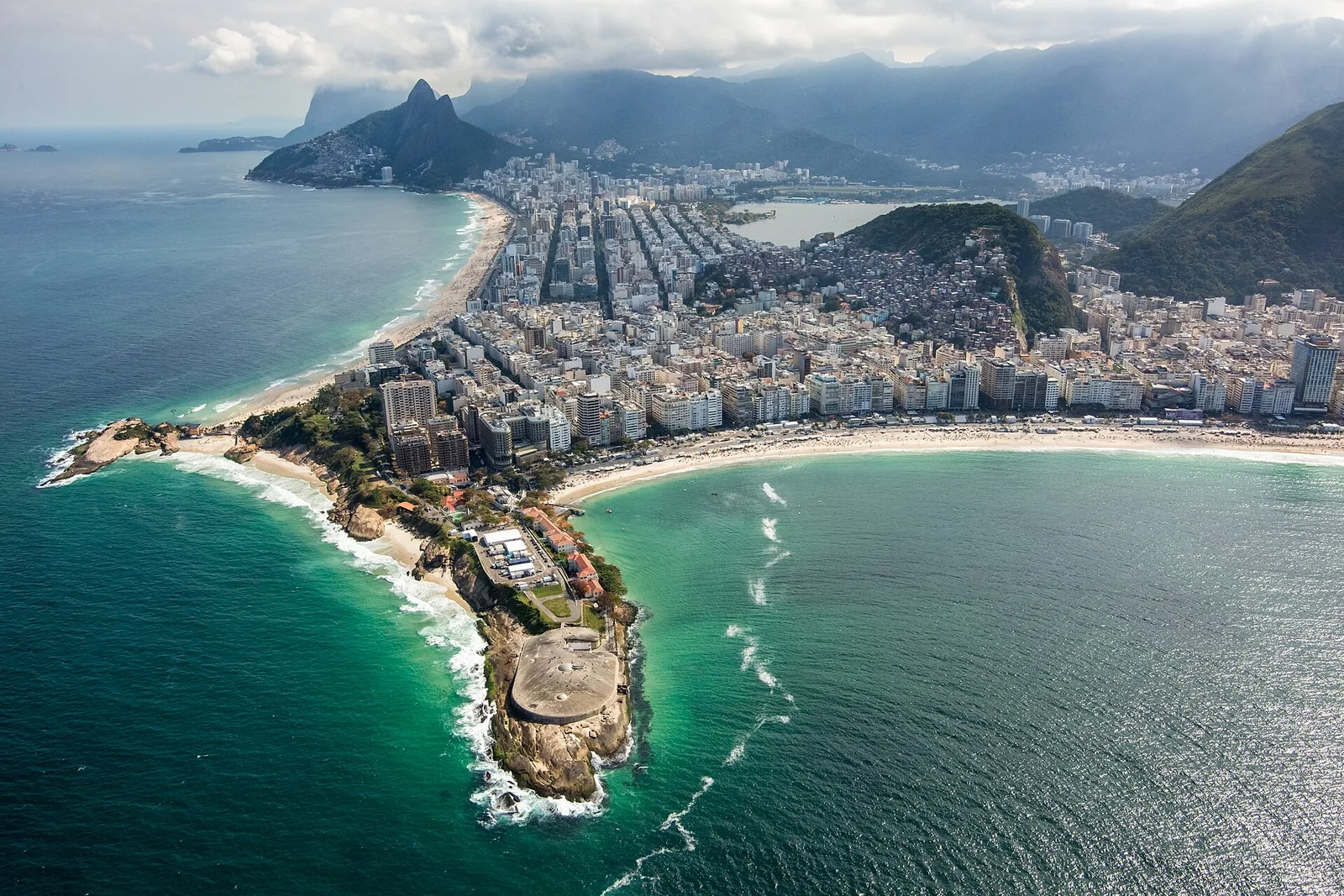
There is a reason Rio feels less foreign to a European than the map suggests, and it smooths the whole decision. Rio is, in its bones, a partly European city, and each nationality finds its own thread. The French recognise the belle-époque boulevards and the modernism that grew in dialogue with Le Corbusier; the great curving Copacabana promenade is a European idea of a seafront, transplanted. The Portuguese, and Iberians generally, find the language no barrier and the colonial-and-imperial architecture deeply familiar. The Italians — and this surprises people — find a country shaped by one of the largest Italian emigrations in history, with millions of Brazilians of Italian descent, an Italian imprint on the food and the family culture of the south, and a warmth of daily life that reads as Mediterranean. A European who walks into a well-proportioned 1950s Ipanema apartment recognises the grammar of good European living immediately; the light is different and the sea is at the end of the street, but the language of the space is one they already speak.
That affinity matters because it lowers the psychological barrier to buying abroad. A European is not emigrating to somewhere alien; they are discovering a warmer, more spectacular cousin of the urban civilisation they come from, at a fraction of the price. It is the reason so many European buyers describe the decision, once made, as feeling less like a leap than like a homecoming to a place they had somehow always half-known — and it is a quiet but real part of why the European wave, once it started, has kept building.
07 · Three European buyers, 2026
The wave is easier to believe as three composite people, profiles preserved.
The Parisian. A Paris couple approaching retirement, tired of rent-controlled yields and mindful of the IFI, bought an Ipanema three-bedroom to run as a hybrid through us — their own use in the European winter, professional short-stay the rest of the year — and treat the yield as a supplement to a French pension that buys less warmth each year. Rio gave them the half of the year Paris cannot.
The Londoner. A London buyer in the City, reassessing everything after the non-dom change and unwilling to pay the stamp-duty wall on another London property, bought a Copacabana seafront apartment as a diversification, a yield play and a residency foothold in one move, and works the London winter from a terrace above the beach. The entry cost, he noted, was a fraction of the SDLT he would have paid at home.
The Milanese. A Milan-based entrepreneur with the deep Italian-Brazilian family ties so common in the south of Brazil consolidated a low-yielding Milan investment flat into a larger, higher-yielding Leblon apartment, calculating that the Rio yield, the family connection and the foothold outside the EU all pointed the same way. Three capitals, three national reasons, one city — and the same continental forces underneath.
08 · Where the money is landing
European money, like New York money, concentrates rather than spreads. Lifestyle-first European buyers — the Parisians and Milanese buying a place to live part of the year — land in Ipanema, Leblon and the greener corners like Jardim Botânico and Lagoa, drawn to the walkable, cosmopolitan, family-friendly texture that reminds them of the best of home. Yield-first buyers, more common among the British and the diversifiers, land on the Copacabana seafront where the short-stay numbers are strongest. Foothold-and-optionality buyers spread across all of them, choosing the apartment that makes the cleanest asset and the cleanest residency case. The product that moves most is the solid, well-located two-to-four-bedroom in a good building — the apartment that is both a pleasure to inhabit and a strong performer, because most European buyers, like most New Yorkers, want it to do both jobs.
09 · Beyond the four capitals — the wider European map
I have led with Paris, London, Lisbon and Milan because they are the four accents I hear most often, but the European wave is broader than those capitals, and the breadth is itself part of the story. From Zurich and Geneva I see buyers for whom the Swiss franc's strength makes the Rio discount even deeper, and for whom a warm-weather, higher-yielding asset is a welcome contrast to the famously low yields of Swiss residential property. From Amsterdam and the Randstad I see buyers pushed by one of the most aggressive short-let crackdowns in Europe and by a housing market that has become punishingly expensive for what it returns. From Madrid and Barcelona I see buyers who watch their own cities move to phase out tourist rentals and who understand, better than most, exactly what it means for yield when a government decides holiday letting is the enemy of housing. From the Nordic capitals I see buyers chasing the sun with an intensity only a Scandinavian winter can produce, for whom the counter-seasonal Rio summer is worth more than any spreadsheet can express.
What unites this wider map is the same continental logic that unites the four headline capitals: a strong home currency, a home market that yields little and is regulated ever more tightly, and a growing wish for a base beyond the Union's perimeter. The specific push varies — a tax here, a short-let ban there, a currency edge somewhere else — but the destination is the same, and the fact that buyers from a dozen European countries are arriving at that same destination in the same eighteen months is the clearest possible sign that the forces at work are structural rather than local. A buyer from any of these places should take comfort that they are not making an eccentric solo bet; they are part of a broad, rational, continent-wide reallocation that simply has not yet been named as one.
10 · A worked example, in euros
Abstract drivers persuade the head; a concrete example persuades the gut, so here is the shape of a real European purchase, rounded and indicative rather than a promise, at a budget I see often — one-point-two million euros deployed into a prime Ipanema apartment. At recent rates that is roughly six-and-a-half to seven million reais, which buys a genuinely beautiful three-bedroom of around a hundred and sixty to a hundred and eighty square metres in a good building a short walk from the beach. Add the all-in Brazilian acquisition costs — the ITBI transfer tax, notary, registry, legal and the money-movement — at six to eight per cent, and the euro buyer is all-in for something in the region of one-point-three million euros including costs.
Now the income. Run as a professionally managed hybrid — the owner's own use for part of the European winter, short-stay the rest of the year — an apartment of this quality in Ipanema can produce a gross yield in the seven-to-ten-per-cent range on the property value. Take the honest haircut: management, cleaning, platform fees, vacancy, the condomínio, the IPTU and the fifteen-per-cent Brazilian rental tax together remove something like a third to a half of the gross, landing a net yield in the rough vicinity of four to six per cent in euro terms after Brazilian costs and tax — before whatever your own country's tax adds, which the foreign tax credit or treaty relief substantially offsets. That is a net yield a prime Paris, London or Milan apartment cannot approach, on an asset bought at a currency discount, in a city you will actually enjoy using. The example is not a guarantee — every apartment and every year differs, and the currency can move either way — but it is the honest shape, and it is why the European numbers, once run, tend to survive the skepticism a good European buyer brings to them.
11 · The bear case: what could narrow the window
An honest market piece owes you the argument against itself, and I would rather make it myself than have it ambush you later. The single largest risk to the European thesis is the one that is also its foundation: the currency. The Rio discount exists because the real is weak, and a real that is weak can become weaker, which would soften the euro or sterling value of both the apartment and its income even as they perform in local terms. A European buyer must be honest that they are taking currency risk, size it so that a further fall would be uncomfortable rather than ruinous, and treat the apartment's use and local-currency yield — not a currency bet — as the reason to own it. The second risk is regulatory symmetry: Rio's short-stay permissiveness, which underpins the yield advantage, is not guaranteed forever, and while the buyer-relevant Zona Sul remains permissive today, a European should assume the regulatory direction globally is toward tightening and not underwrite a yield that depends on the rules never changing.
The other honest debits are the ones every comparison in this Journal names. Distance is real: a long-haul flight and a modest time difference mean a European should buy Rio for meaningful stays, not casual weekends. Liquidity is lower than a European capital: a well-priced Rio apartment sells in months, not weeks, and a European should not buy anything they might need to liquidate on short notice. And safety is a genuine consideration, managed rather than dismissed, through the right neighbourhood, building and habits, as I discuss at length elsewhere on the site. None of these debits sinks the case — the whole series exists because, weighed against the drivers, they generally do not — but a European who buys without having written them down is not ready to buy. Put them on the page, size them honestly, and then decide.
There is a subtler risk in a wave, and an honest market piece should name it: the risk of the crowd itself. When European buyers from a dozen countries converge on the same handful of Rio neighbourhoods in the same short window, they can, at the margin, bid up the very prices that drew them, and a buyer arriving late in a wave can pay more than a buyer who arrived early. I do not think prime Rio is anywhere near that point — the market is deep, the currency discount still dominates, and foreign buyers remain a modest share of overall transactions — but a European should buy the specific apartment on its own merits and its own numbers rather than on the momentum of the wave, because "everyone is buying" is a reason to check your discipline, not to suspend it. The buyers who do best are the ones who would be happy with the apartment and its yield even if no wave existed.
The second risk a European should weigh honestly is Brazilian policy risk in the broad sense — not a reason for alarm, but a reason for realism. Brazil is a large, complex democracy with its own political cycles, its own fiscal debates, and its own periodic bouts of currency and interest-rate volatility, and a European accustomed to the relative placidity of home markets should expect more headline noise than they are used to. The property itself — a registered apartment in a solid building, held by a foreign owner with clean title and registered capital — is well insulated from most of that noise, and Brazil's legal framework for foreign property ownership has been stable and welcoming for decades. But a European should hold the position with the equanimity of someone who understands they have bought into an emerging market, with the volatility that label implies, and should size the exposure so that a noisy year is uncomfortable rather than destabilising.
The third thing to guard against is the most human: the "it feels like a bargain" trap. The currency discount is real, and it makes a European feel they are getting so much for their money that the ordinary disciplines of buying — independent legal diligence, an honest read of the building, a sober view of the net rather than the gross yield, a professional operator — can feel almost unnecessary. They are not. A discount is not a substitute for diligence; if anything, the feeling of a bargain is precisely when a buyer is most tempted to cut the corners that protect them. The Europeans who buy well bring the same rigour to a cheap Rio apartment that they would bring to an expensive Paris or London one, and the discount rewards their diligence rather than replacing it.
So who, honestly, should act on this wave, and who should not? It is for the European who will use the apartment for real stretches — the winter escape, a remote-work season, the long holidays — and who funds it from capital they can hold patiently; for the diversifier consolidating a low-yielding home asset into a higher-yielding foreign one; and for the buyer who genuinely values a foothold outside the Union. It is not for the European who needs the money liquid within a year or two, who cannot stomach currency and emerging-market volatility, or who is buying purely because others are. The wave is real and the alignment of forces is unusually complete, but the right response to a wave is to decide whether you belong in it on your own terms — and this piece has tried to give you the honest inputs to make that call rather than a push to join the crowd.
It is worth naming the two moments in the Rio calendar around which European buyers most often organise their year, because they are a real part of the pull and they fall with perfect cruelty in the depth of the European winter. The first is Réveillon — New Year's Eve on Copacabana, when some two million people in white gather on the beach for one of the great spectacles on earth, fireworks over the Atlantic, the sea full of offerings. The second is Carnival, in February, which needs no introduction and which empties every superlative anyone brings to it. A European who owns an apartment in the Zona Sul owns a front-row seat to both, in the months when Paris and London and Milan are at their coldest and darkest, and a great many European buyers structure their ownership precisely around being in Rio for one or both. The apartment earns from a global stream of visitors for those same peak weeks when the owner is not using it, which is exactly the hybrid model that makes the numbers work.
A closing word on integration, because it is the quiet thing that turns a European's Rio ownership from a transaction into a life. The cultural affinity is real, but it rewards a little effort: a European who learns some Portuguese, who treats the building's staff and neighbours as the relationships they are, and who arrives with curiosity rather than a coloniser's convenience finds a warmth and a welcome that no brochure conveys and that transforms the experience of the place. The French find their belle-époque echoes, the Iberians their language, the Italians their vast diaspora cousins — but all of them find more if they meet the city halfway. The European wave is real and rational on the numbers; the Europeans who are happiest in it are the ones who bought the apartment for the yield and then fell for the city on its own terms, which, more often than not, is exactly what happens.
And a practical footnote on getting there, since it shapes how a European actually uses the apartment. The nonstop routes are good and improving — Air France from Paris, British Airways from London, TAP through Lisbon, and LATAM from several European hubs — so most European buyers reach Rio in a single flight of around eleven to twelve hours, landing into the afternoon with the evening ahead. That single-flight reality, into a modest time difference and a hemisphere's summer, is what makes the twice-or-thrice-a-year winter escape genuinely practical rather than aspirational, and it is worth confirming the route from your own city before you buy, because a convenient nonstop is part of what turns a Rio apartment from a distant idea into a used and loved part of a European's year.
12 · Why now, not later
The thoughtful European asks the same last question the New Yorker does: if the case is this strong, why is the window still open, and how long will it stay. My honest answer is the same — the window is open now and unlikely to stay this wide indefinitely, for one central reason, the currency. The generational discount a euro or sterling buyer enjoys in Rio exists because the real is near multi-year lows, and currencies are cyclical. The apartment's yield and lifestyle appeal, and the regulatory contrast with a tightening Europe, would persist even if the real recovered; but the specific home-currency entry advantage that makes prime Rio feel like an inefficiency to a European is a function of an exchange rate that will not sit at these levels forever. The buyers who enter near a cyclical low of the real tend to look wisest a decade on.
I will not predict the real's path, because no one honestly can. What I will say is that the alignment in front of a European buyer in 2026 — a strong home currency, a continent that has taxed and regulated its property yield into the ground, a genuine foothold outside the Union, and a city that feels like a warmer relative of home — is an unusually complete one, and completeness like this is usually obvious only in hindsight. If you want to understand what it would mean for your specific numbers rather than in the abstract, start the conversation here, and the Paris and London comparisons sit alongside this piece as your next reading.